Arboreality - Tree Blogging
Showing posts with label flowers. Show all posts

Friday, March 21, 2008

Emergence Among the Trees


The forests are still sleeping in Eastern Pennsylvania, but these photos from Ridley Creek State Park last month show the quiet emergence of ferns and other flora. I couldn't resist sharing photos of Snowdrops and Winter Aconite from my own garden taken earlier in March. Coming up at Arboreality: the first signs of swelling tree buds.

Tuesday, January 22, 2008

Winter Reds


Monday, May 21, 2007

The Land of the Fae


(This is definitely a picture you want to click to enlarge.)

Friday, April 20, 2007

I Love Dandelions!


I grow dandelions in my gardens, with my vegetables and flowers, and in my cold frame. I don't care what you call them, I think they're beautiful (and delicious)!

Wednesday, April 11, 2007

Scilla Shows Signs of Spring


Scilla flowers (), brought to my gardens from Europe by the owner’s mother many years ago.

Thursday, April 05, 2007

Le Printemps est Arrivé!


Spring has definitely arrived, but I smell snow in the air this morning!

Friday, March 09, 2007

No No Zoto


Well, my photo hosting at Zoto is no more, so please bear with me – our forested header and icons will return shortly!

As you can see, Spring is not far off here outside Philadelphia!

Friday, September 29, 2006

Friday Daisies


Those who know me know that daisies and dandelions and flowers of their ilk are among my favorites.

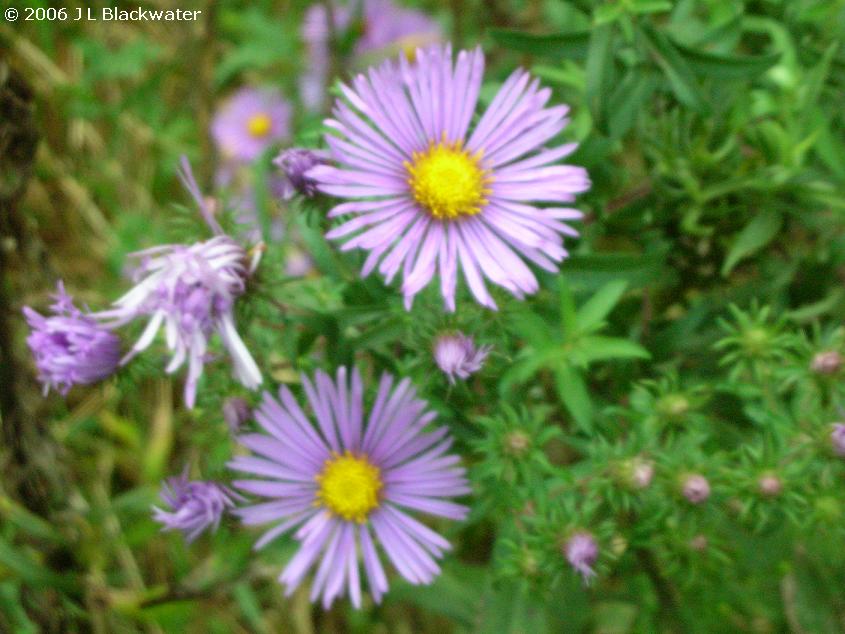
This purple beauty is new to me – I discovered it in the open flower fields at Longwood Gardens, and identified it this week via the blog Beyond the Fields We Know as the Michelmas daisy or Purple aster (Symphyotrichum novi-belgii or Aster novi-belgii).

Over at Pollen Nation, the Daily Flower for September 27th is the dandelion. Hop over to learn more about this beautiful, sunny wonder!

Thursday, September 28, 2006

Flowers in the Wind


Busy today... more tomorrow from Longwood Gardens, including flowers like those seen here from the fields.

In the mean time, if you're looking for something interesting about forests, hop over to Caroline's blog Earth Friendly Gardening for her latest post about a new report on the "value" of in-tact forests.

Monday, September 11, 2006

Where to begin?


I have so many amazing things to share from the trees that just I couldn’t decide where to start this morning.
Enjoy the flowers for now, more to follow soon!

Wednesday, September 06, 2006

More on wildflowers


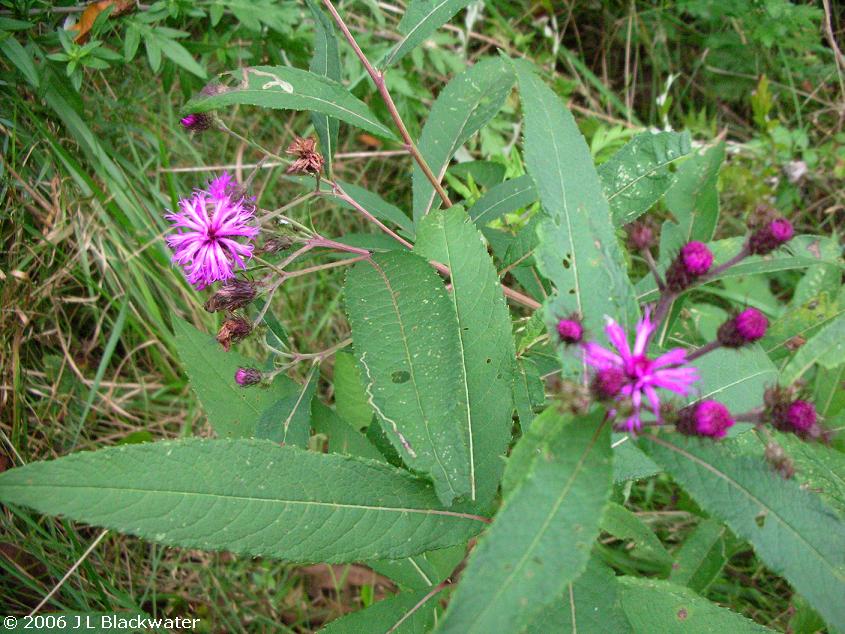
I just had to share more of the flowers. The purple ones are still unidentified, although Jenn gave us some great suggestions yesterday, and also revealed the identity of the yellow flowers for us. I thought some pictures showing the leaves of the other two might help us in our quest for identification.
UPDATE: Jenn was right on track with the family for the white flowers. I found their identity from the website of the same horticulturalist (Bob Zuberbuhler) who helped us with the lesser celandines. The white flowers are Horse-nettle, and they are indeed making these crazy little green "tomatoes." I'll get a picture of those for you soon! Still stumped on the purple ones... the flowers look thistle-y, but the leaves just don't match!

The blue flower you see next to the house is sort of a kindred spirit of mine. There are a few different morning glories growing around here – white ones, pink-and-white striped ones, and these blue ones. The blue ones are only open in the mornings, and on overcast days. As soon as that sun breaks loose, they curl up into these whithered-looking purple clumps, and it looks like they aren’t even there!

Now, I know that the sun does some very important things for the Earth and her inhabitants, but I really think I could live in a place where it was permanently cloudy, grey, and rainy, and be perfectly happy.

And yes – those “weeds” comprise my “flower bed.” Hey – I like the local flora! Besides, you have no idea how educational it has been to just let the birds and the wind determine what’s growing next to my house. Virtually all these little herbaceous plants are new to me, and even if I start to plant bulbs and other flowers this autumn, I intend to allow the natives to persist right along with them. Oh yes - and I must go pirate some of that bee balm soon!

Coming up: emergent fungus, butterflies and caterpillars, and the stockpile of the red squirrel (or, the ballad of the Red Headed Stranger).

Friday, July 21, 2006

Mystery flowers strike again!


Next week we have not one but two different mulberries to explore. What is their true identity? Ha! We may never know; but explore them we shall.

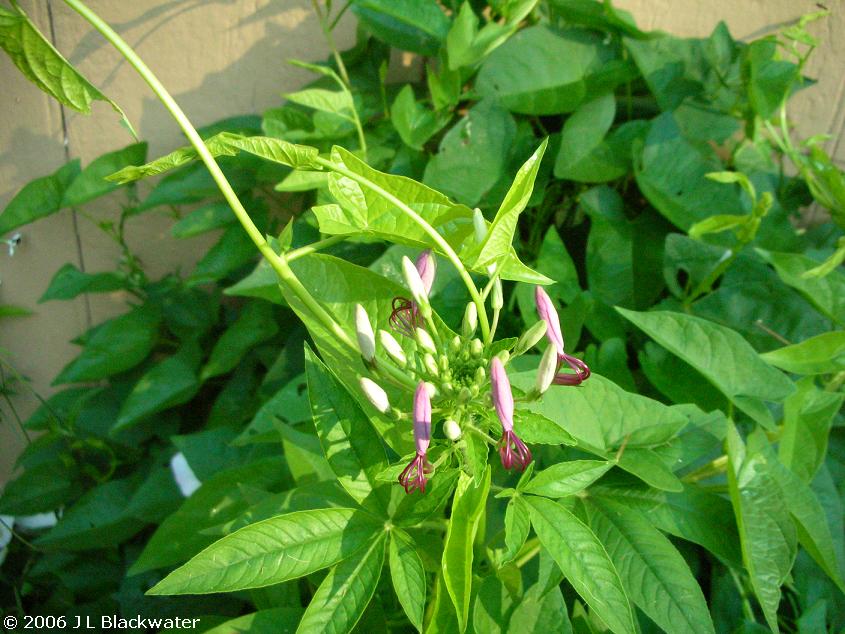
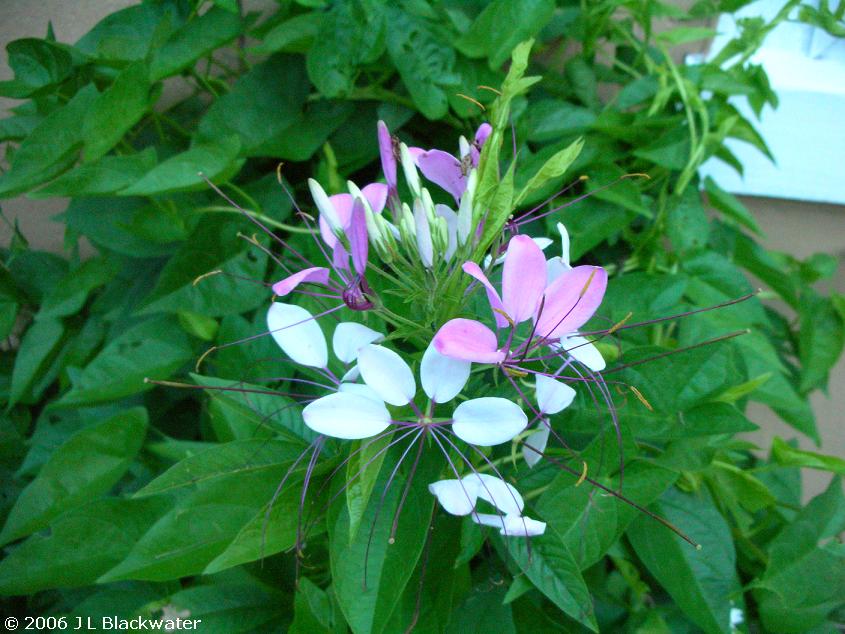
Today, I just could not resist sharing this unique, beautiful flower which sprang up almost over night in my little flower bed. I have not clue as to what this is, and I cannot find it growing anywhere else.


It appears to have emerged from a towering mass of white morning glories (yes, I know that they are “weeds” and I have them happily growing along with my carefully cultivated dandelions, thank you!).

You can see how it’s opened up over the last few days in these three shots. Each successive layer adds another uni-petal to the spindle of flowerets. I believe that those palmate-looking leaves are what belongs to this plant, but I am completely at a loss as to its identity.


I’ve got to get me an herbaceous identification book to compliment my tree identification books! Suggestions and theories are all welcome. Have a great weekend everyone! Hug a tree. :)

Update: Mystery solved - what we have here is cleome! Thanks Xris for your help! (For details, see the comments).

Tuesday, July 18, 2006

Sunrise at the Farm


More on mulberries soon folks!

Wednesday, June 28, 2006

Bee Balm, Beech, and Berries


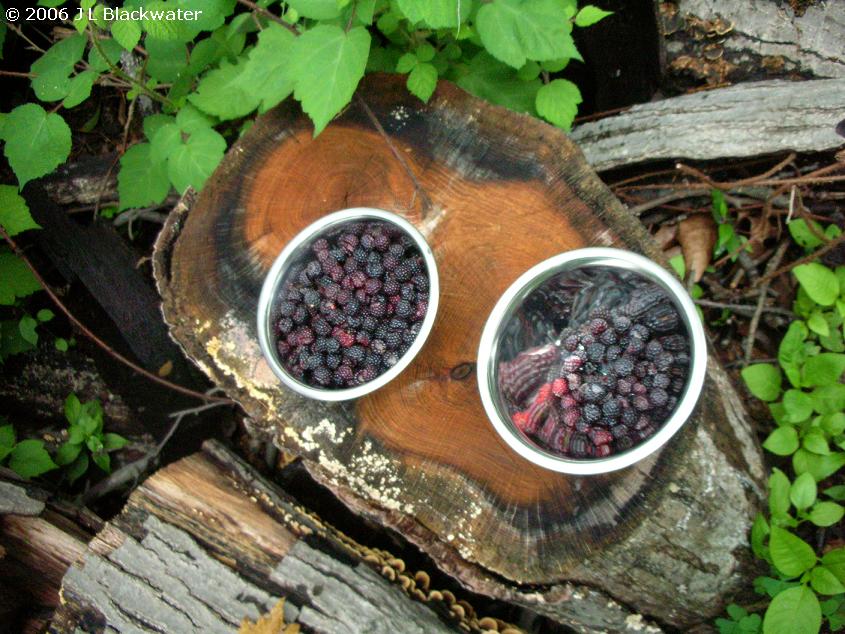
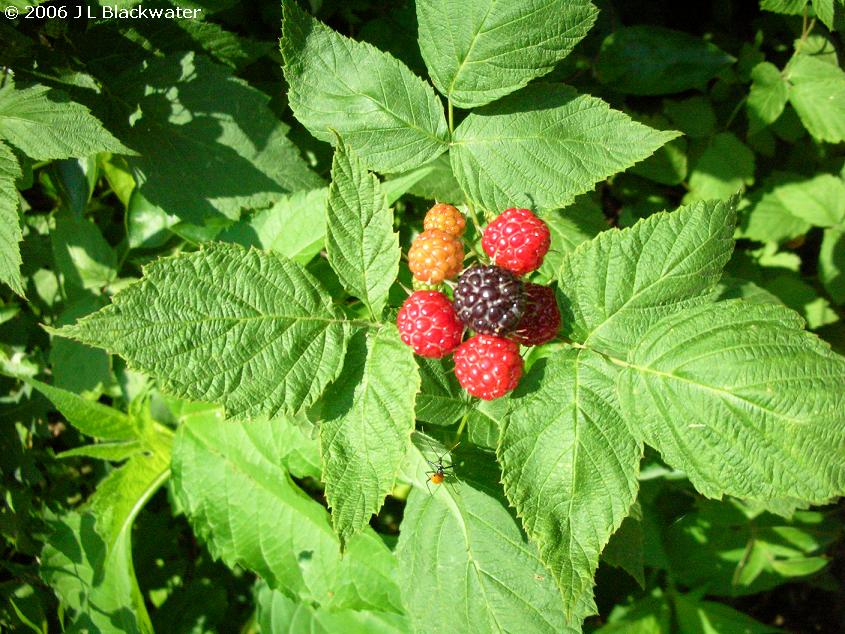
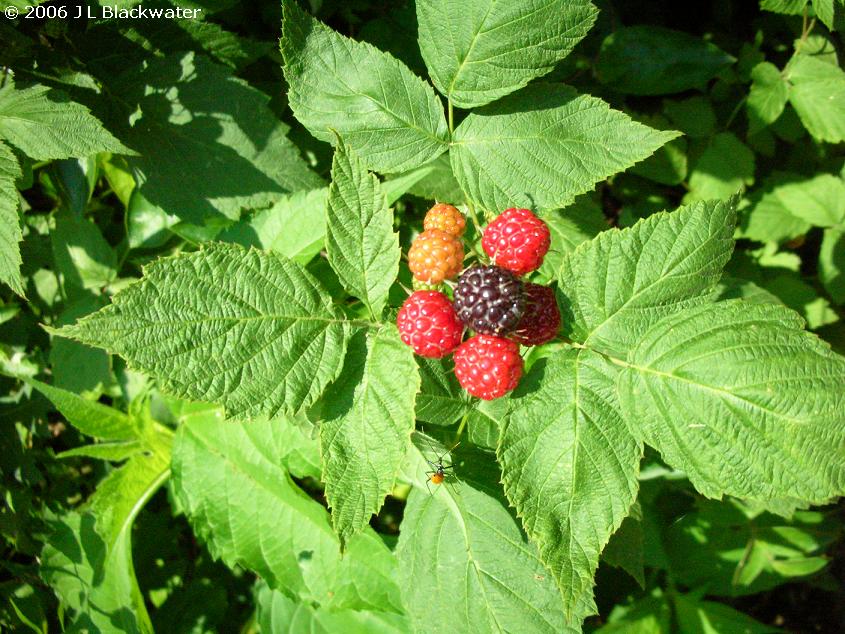
Monday I ventured out to pop some things into the mailbox, when I was sidetracked by the black raspberries growing along the driveway (like the ones you see in the June solstice post). I had collected a handful when I realized that the awesome rain we’ve been having had ripened more than a mere sprinkling of berries; after running all the way back to the cottage for some bowls, I returned to the driveway and began picking.

As I made my way in around the gardens of the mainhouse, I found many amazing things in bloom. There are several of the Japanese snowbells growing near the playhouse, and I realized that someone must have brought a transplant to my cottage years ago. I also found many surprises in the brush beneath the trees as I berry-picked my way through the gardens. Flowers from many previous generations are still raising a hand here and there among the wild brush and from underneath the trees.

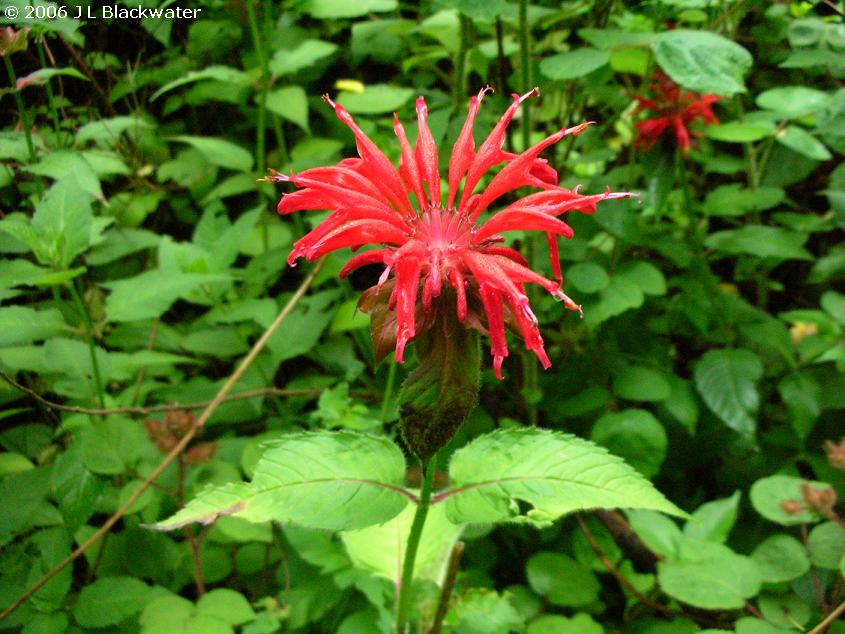
Nothing could have prepared me, however, for the righteous show of red that the bee balm flowers possess. There I was, minding my own business, picking and wandering, when these beautiful red flowers practically jumped out from under the beech tree. After staring breathless for a moment, I remembered my camera and brought some images back to share with you. This is the first time I’ve ever seen bee balm; once they’re done flowering, you can bet I’ll be over with a shovel and a will to transplant!

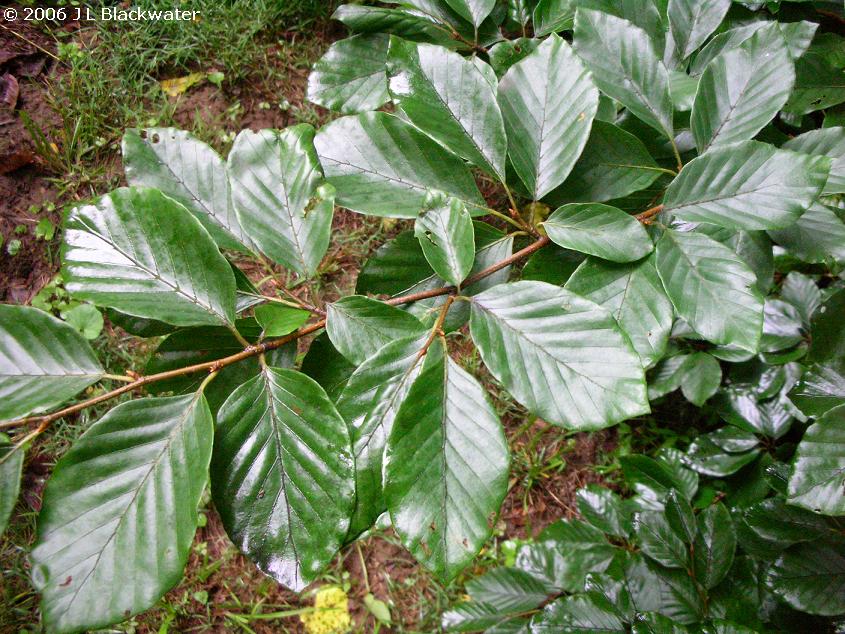
As I turned around to survey the beech tree, I saw that her fine leaves have matured from their pale green youth into a deep leathery green. You can see how this wonderful rain makes the leaves glisten. I’m still trying to get used to 80-degree weather with rain, but it makes for some wonderful gardening! I managed to get a healthy three or four cups of those tiny berries, and I have the half-eaten pie to prove it!

Sunday, June 25, 2006

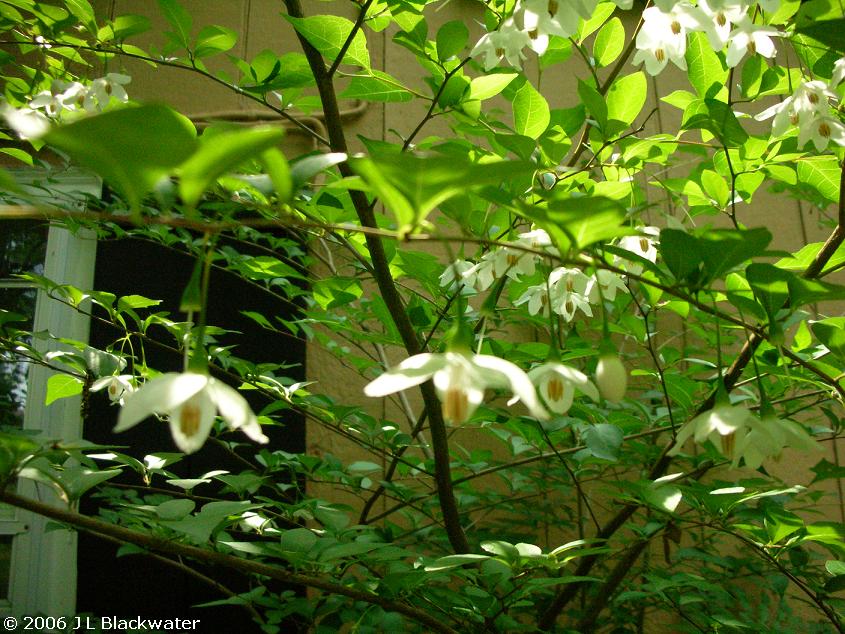
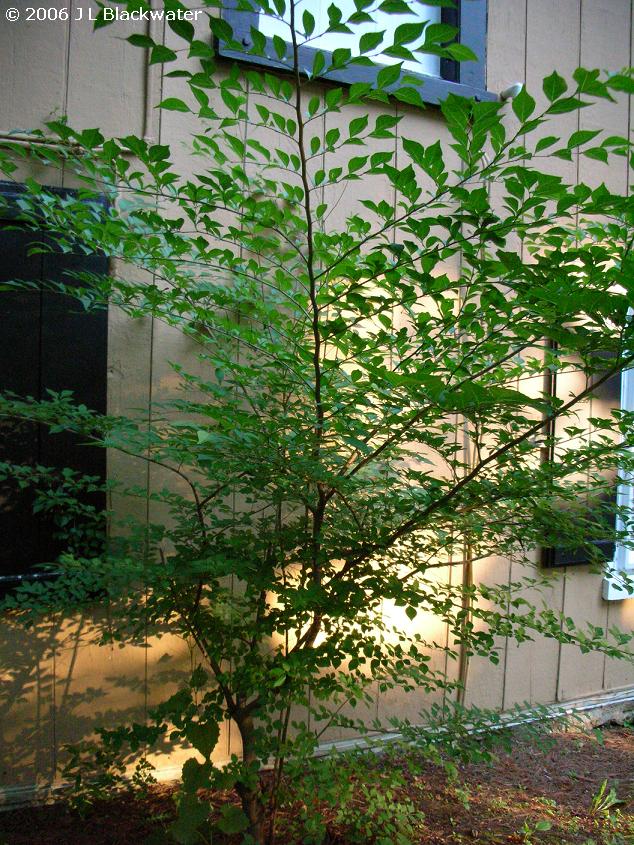
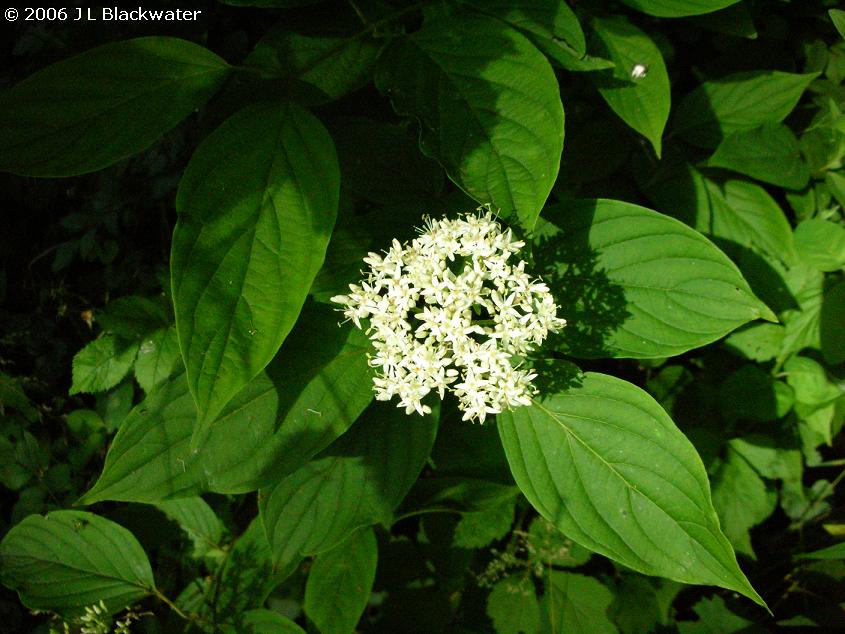
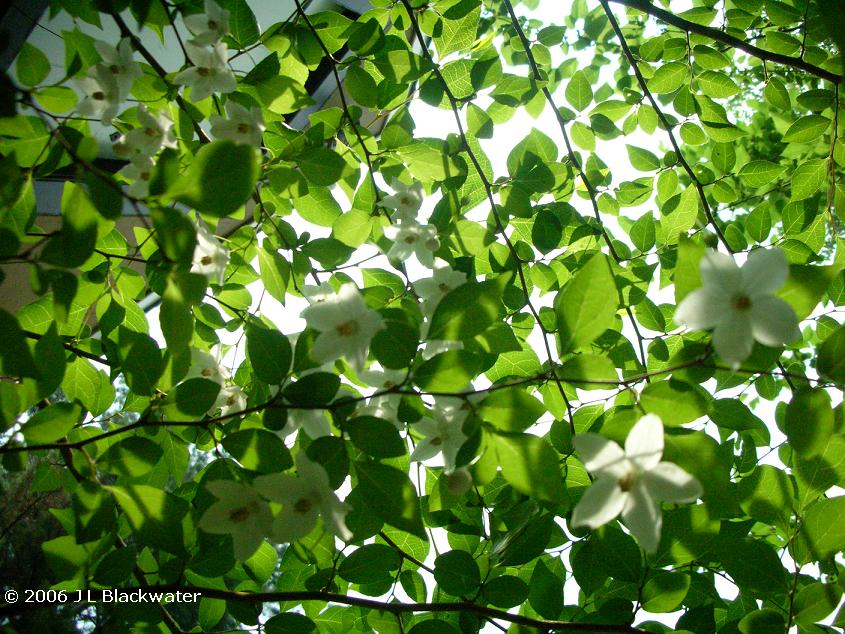
White flowering mystery tree


By popular request (and because I’m dying to know), we’re going to take a closer look at the mystery tree featured in Dad’s Father’s Day post on June 18, 2006.

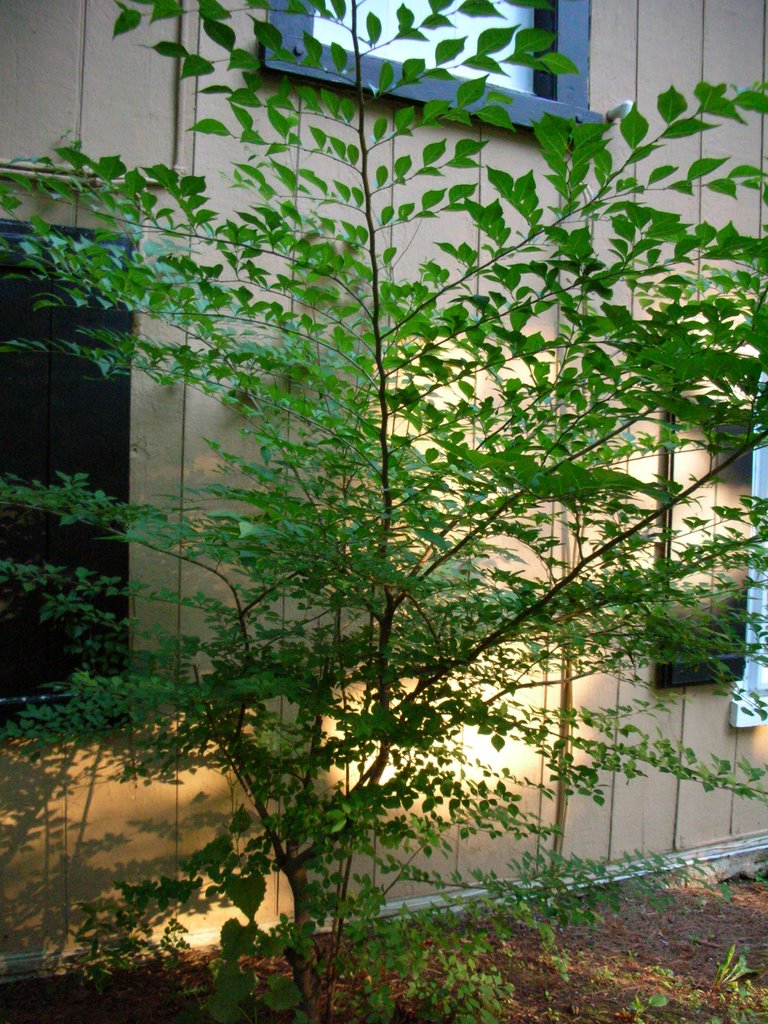
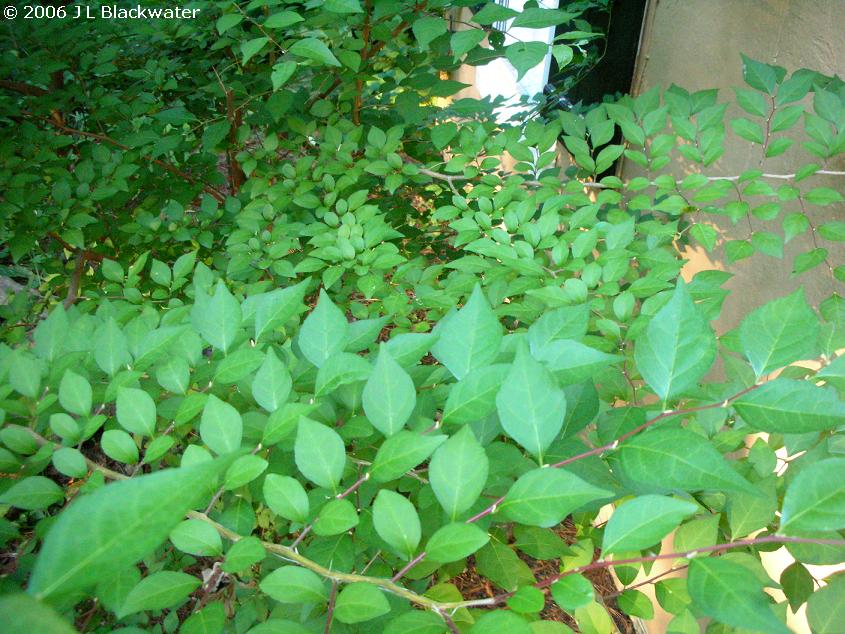
This tree planted in front of my cottage is about my height, bringing it to an estimated 1.5 meters tall. Having only lived here for six months, I have no idea how long this tree has been in this spot. This makes it hard for me to gauge as to whether it is a young tree, or a small-growing species.

Leaves are no greater than maybe four or five centimeters in length, the flowers are about two centimeters in diameter (max). These leaves grow alternating along the branch, with almost-smooth edges. The edges appear to have very non-distinctive, slight “teeth” that stretch length-wise along the sides, but are difficult to see in these images.

It’s really too bad that the flowers didn’t stick around very long, because they were just so lovely! The flowers hang underneath the branches in pairs of two, as you can see clearly in the unopened buds of the final image. Just a few small, round, green “fruits” are now swelling where the flowers once bloomed, but aren’t distinctive enough to give me any clues about this tree’s identity.

All thoughts and suggestions are welcome as usual, and in the meantime, file this one under Tree, Mystery.

Wednesday, June 21, 2006

Solstice Greetings!


Happy Summer Solstice to everyone in the northern hemisphere, and Happy Winter Solstice to all in the southern hemisphere!

Monday, June 19, 2006

Think think think


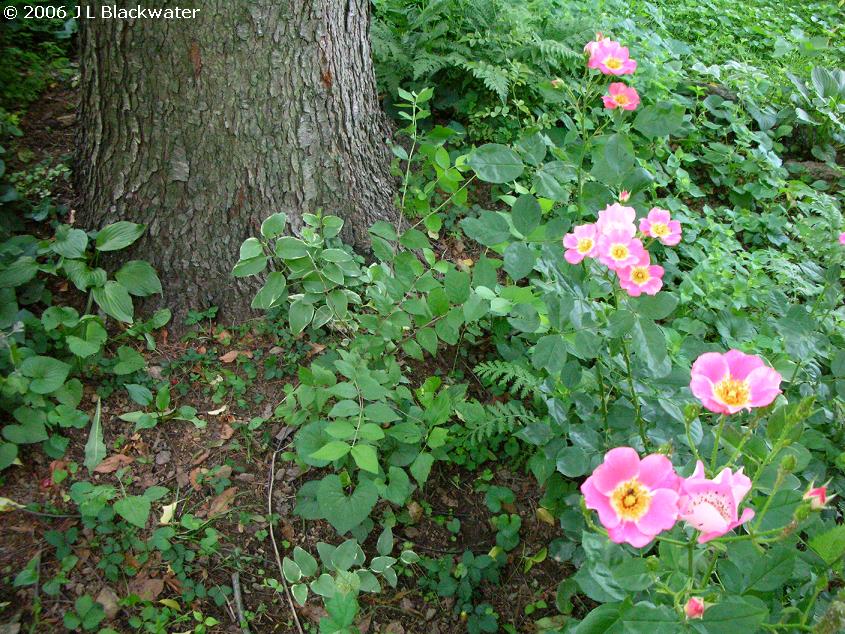
This tree beside the cottage has a wonderful voice. It always tells you when the rain is coming, and loves to chatter. This tree also loves to listen. Beneath it, the neighbors have planted the roses with other flowers and ferns, creating a quiet little thinking spot.

Sunday, June 18, 2006

For Dad


Happy Father’s Day Dad! These are for you! And Happy Father’s Day to Grandpa Tom, too!

The first image is a trillium which I caught an image of while still living in Olympia, Washington. Trailhead also has some righteous trillium photos at Trailhead Images. (From what I remember, Dad loves trilliums as much as I do).

Our second image is of the mystery elm. One of these days I’ll be able to give you a definitive answer as to its identity!

Third we have another mystery tree. I am at a complete loss as to what it might be: this tree is growing right next to the house in the front yard, and was obviously planted there by humans. The little flowers surprised me literally overnight, and disappeared almost as quickly. Any ideas as to what she could be?

The fourth image is of a beautiful mystery plant. While this plant has much the same shape as a young fireweed (among my favorite flowers), I know that it can’t possibly be the same plant. Fireweed would be WAY bigger by now!

My dad’s many interests include different branches of botany, and with that, paleobotany. There’s no doubt that my father’s interest in all things green and my parents’ decision to live in a well-treed place has fed my own natural love for trees and plants, and digging in the dirt.

Dad and Mom have provided me with numerous tree books, and my trusty camera, both of which are critical tools used in creating Arboreality, and in continuing my own botanical studies. To both Mom and Dad, thank you!

To Dad, and all fathers:
I wish you a very happy, relaxing Father’s Day!

Thursday, June 15, 2006

Back in the Hedge


Remember when we explored the hedge in the winter? Well, you’d hardly recognize it now! All those bare branches and rose trailers are in full leaf, and the hedgewalls are drooping under their own weight of fresh leaves and blossoms. Now when I venture into the hedge, I have to squat or crawl through most sections, often in near-blackness.

While I have not yet identified some of the smaller trees in the hedge, the multiflora roses (rosa multiflora) which comprise a fair portion of the hedge gave a wonderful showing in recent weeks along with the Japanese honeysuckle and grapevines. The whole world was saturated with the sweetness of flowers, a welcome visit to follow all the cherries and other flowering trees of mid-spring.

The multiflora rose was introduced to this region in the 19th century, and recommended for hedges just like these. However, over time, this species’ rapid and easy proliferation has shown its more invasive qualities, and careful management of this plant is now encouraged. Nonetheless, it makes for a beautiful, animal-friendly environment.

The birds, deer, bunnies, foxes, and other creatures have always frequented the hedge – but with the onset of spring they are out in force! I've followed deer through the hedge as they disappear into the woods. When I wander the tunnels, I am immediately surrounded by the red-winged blackbirds, whose usual songs are replaced with a near-quacking sound.

Undoubtedly the nests are near by, and I am being quarantined by the neighborhood watch program. While six to ten birds encircle me from the hedge, one takes the role of giving away my position by hovering over my head mrack-mracking all the while. (I’ve watched them do the same to a fox, and I wonder if I should take this behavior as a compliment, an insult, or merely by-the-way.)

Our image above of one of these red-winged black birds does not do them justice, but it was hard to get a clear picture as they bantered about. Intelligent birds
that they are, all nests were located safely away from the tunnels, so I couldn’t spot any chicks; given their behavior, I didn’t dare try to venture off the trail.

With the roses now spent, it’s a matter of waiting for rosehips to swell and grapevines to fruit. I do not believe these will produce edible grapes, but I did see another variety around my neighbor’s garden, which appear ripe and ready for picking. Looks like I need to bake some cookies and barter a trade!

Wednesday, June 14, 2006

Forest Garden