Showing posts with label Moraceae. Show all posts

Tuesday, June 12, 2007

Mulberries Up Close and Juicy


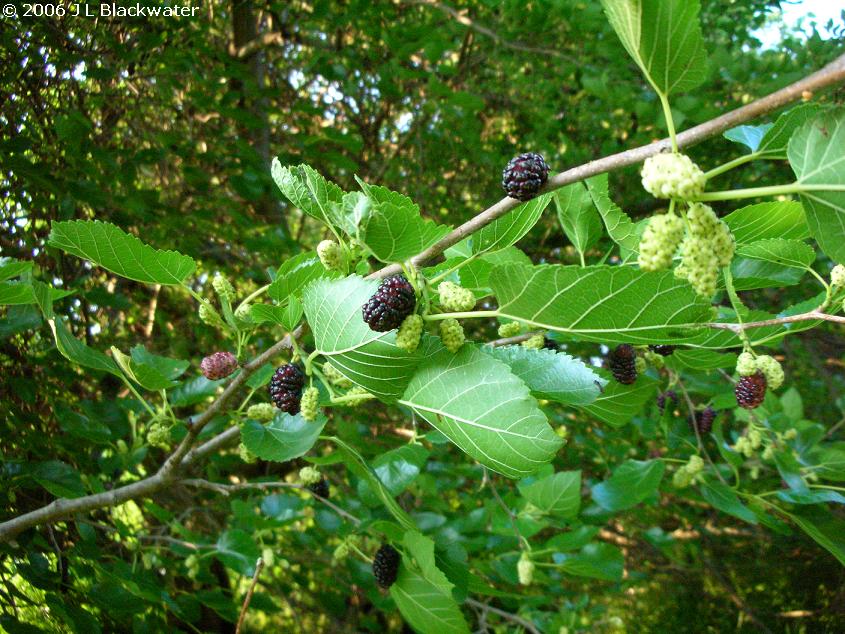
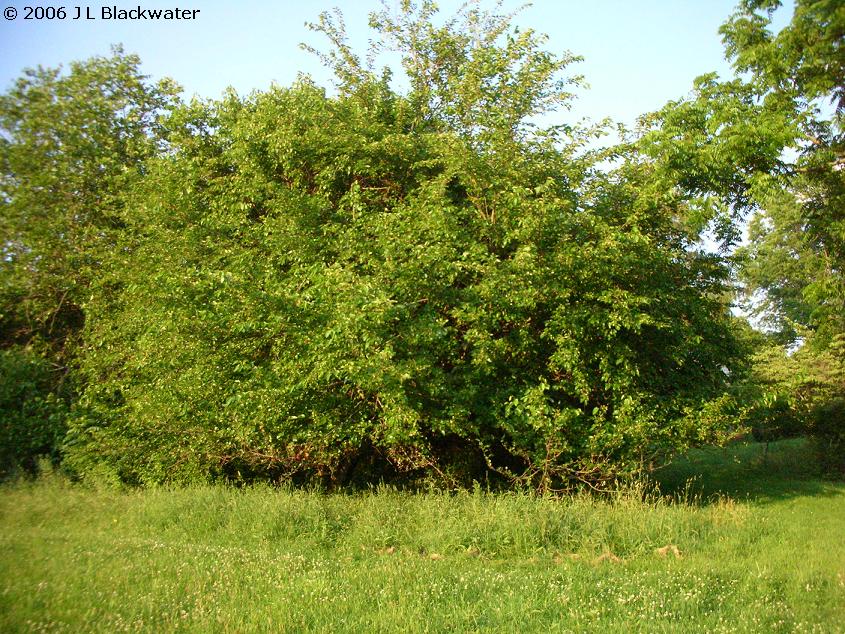
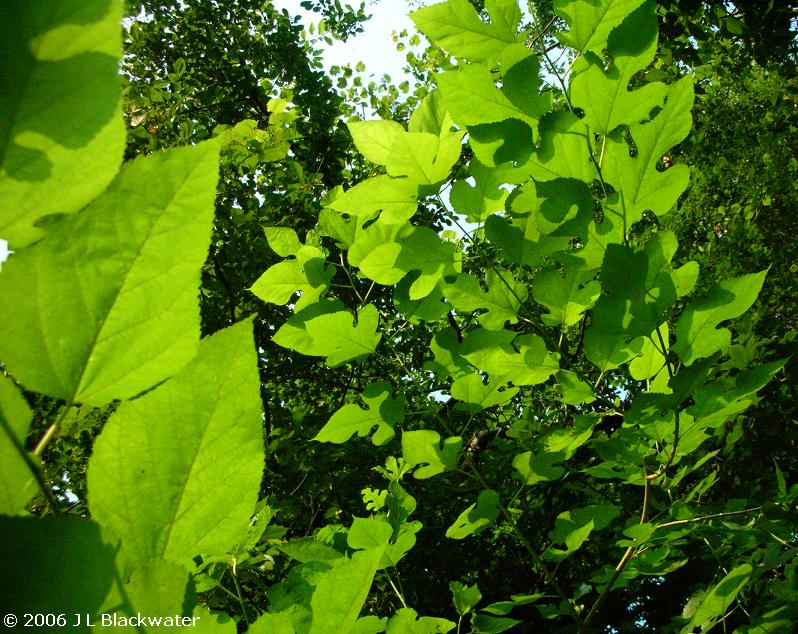
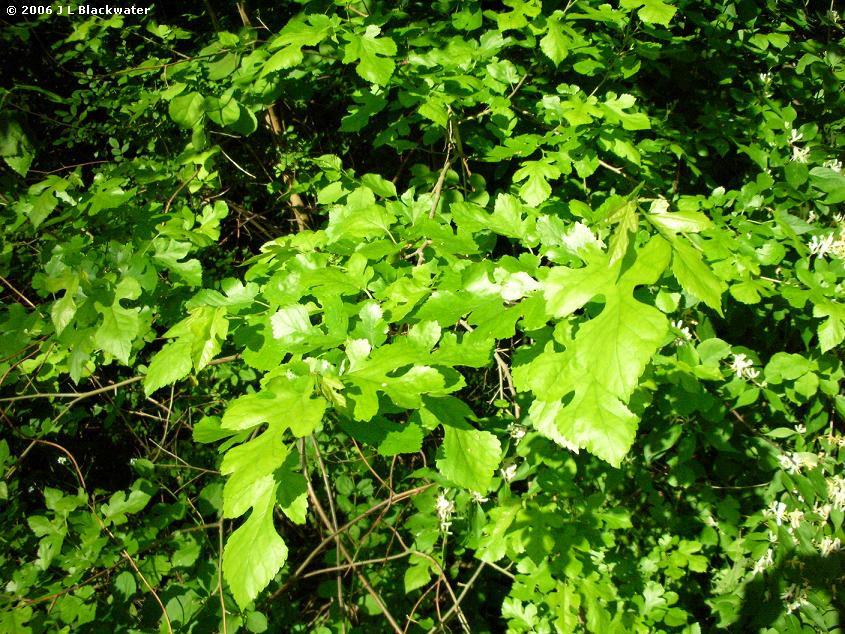
These three pictures (taken yesterday) are of a single mulberry tree growing next to my cottage. It is one of several trees which I originally believed to be Black mulberry trees (Morus nigra), and given Sam’s helpful info on how to distinguish mulberry trees (which I reposted yesterday), I now believe that my first hunch may have been correct.

These trees, while shade tolerant, appear to prefer full sun when they can get it. This particular specimen only gets sun in the evening (which is when these images were taken). They all have the leaning trunk Sam mentions, and the strongly cordate leaf shape. While some of the leaves occasionally have two or three irregular lobes, most do not.

And, as we can see in these pictures, the fruits ripen to a deep, dark purple. My friends the catbirds (Dumatella carolinensis) are busy in these trees right now, and the deer are right behind them!

Monday, June 11, 2007

Mulberry Tree Mystery Chronicles, continued


These images are from two different mulberry tree specimens, and I believe them to be two different species as well. The fruits are starting to mature, and when the lighting is better I’ll share some of those!

For those just joining us, we have a bit of a year-old-mystery on our hands concerning the various mulberry trees growing around the farm where I live outside Philadelphia, Pennsylvania.


Last month Sam gave us some great identification tips in the comments:

sam said...

"To distinguish Mulberrys:

Paper Mulberry (Broussonetia papyrifera) Leaves are densely hairy, and the fruit is round.

White Mulberry (Morus alba) Aggressive tree but shade intolerant, leaves are usually glossy above and the margins have rounded teeth. Ripe fruits tend to be lighter (think pink to purple) than M. rubra or M. nigra, though this is not always the case.

Red Mulberry (Morus rubra) Uncommon, but shade tolerant and prefers moist sites. Can grow to a fairly large size. The leaves are usually rough on top, margins have pointed teeth, and are not as glossy as M.
alba
.

Black Mulberry (Morus nigra) similar to M. rubra, it is the shortest of the lot, often with a twisted, leaning trunk. The best clue is strongly cordate (heart shaped) leaf bases."

I’m confident that sooner or later, we’ll get this all sorted out.

If you’re a mulberry expert, give us your two cents!

Wednesday, May 23, 2007

Morning Mulberry Trees


Some of you long-time Arborealists may recall the “mulberry mysteries” of last year.

To summarize for our new readers, during my first year in southeastern Pennsylvania I have learned that there are at least four varieties of mulberry trees growing domestically and semi-wild throughout the surrounding area. Furthermore, it is entirely possible that there are unique cultivars from cross-pollination, and that these varieties may be indistinguishable from common species (at least at first glance).

The four varieties I’ve read about include Red mulberry (Morus rubra), White mulberry (Morus alba), Black mulberry (Morus nigra), and Paper mulberry (Broussonetia papyrifera). They each have some distinguishing characteristics, but overall I have had limited success with telling them apart. According to The Audubon Society Field Guide to North American Trees: Eastern Region; Elbert L. Little, there are roughly 1400 species in the mulberry family (Moraceae) world-wide; in Eastern North America we can find five native and three naturalized species.

I can see common attributes among certain mulberries, so I know there are a few distinct varieties here at the farm. Characteristics include growth habit, over-all shape, leaf shape and texture, and preferred growing location. Still, there’s nothing definitive for me to point to which makes me confident with identification (not yet, that is).

Today’s images are of a particular species which is common around the farm (this one grows just outside the cottage, so I see it each morning). I believe this variety to be either the Black or the White mulberry.

If you have an opinion on this mulberry’s identity, or tips and tricks from your experience with identifying mulberries in your neighborhood, please do share! In the mean time, I will continue with the mulberry mystery chronicles. Sooner or later, we will find an answer.

Side note: the mulberry family Moraceae also includes the Osage Orange (Maclura pomifera).

Wednesday, July 19, 2006

More Mulberry Mysteries


I think that I am more confused now than when I started! The more time and effort I spend trying to identify and differentiate the mulberry trees, the more discombobulated I become! At this point I am not confident as to which mulberry is which, and whether there is any difference between them at all!

I am relatively confident that we are at least dealing with either red, black, or hybrid mulberries. Apart from that, I cannot say anything with any great certainty. However, my reading indicates that misidentification among mulberries is common, so I suppose that makes me feel a little better!


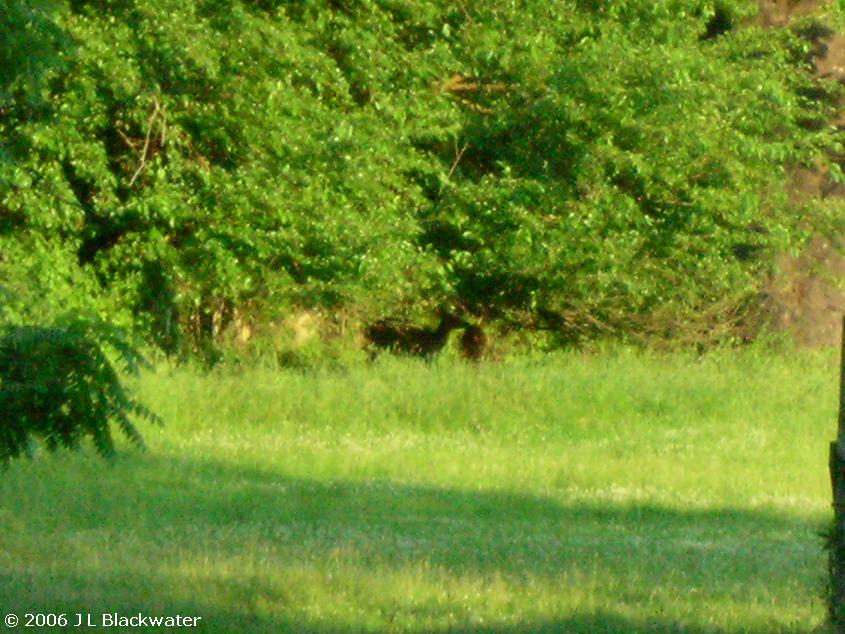
Whatever species it might be, this mulberry tree grows down field near the old silo. All the berries are now gone (these images are from June). The deer really like this tree, and usually take about 10-20 minutes under it in the mornings and the evenings.

After spooking the ones which you can (sort of) see in second image, I crept up and took my turn under the tree. Looking out from that shady, peaceful spot, I think I can see why they like it so much!

I have not given up my attempts to identify these trees, but the prospects are not promising. I am open to any suggestions you might have to offer on the subject! Next up will be another mulberry tree growing near by with some slightly different features!

Friday, July 14, 2006

Black Mulberry Trees


Or are they?

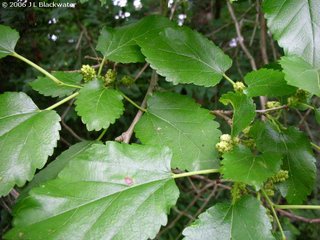
Here is our first page in sorting through the mystery of the mulberry trees around the farm. These images taken in early June are of what I believe to be one of several black mulberry trees growing on the property.

The black mulberries tend to grow in sunnier locations with a larger crown, although overall they are not particularly tall trees. In coming days, I’ll have a few images to share looking at the whole tree.

What leads me also to my conclusion besides the growth habit are the leaves – all of the suspected black mulberry trees have only very occasional instances of irregular lobes, which seems a particular characteristic of the little red mulberries growing in the shadier spots.

When these images were taken, the berries were only just starting to ripen on some trees. I never did get a chance to taste those ripe black, purple, and red berries – the birds were far too fast for me!

Tuesday, July 11, 2006

Mulberry Trees and More Mysteries


I’m still working on sorting out the mystery of the mulberries around the farm. We have at least two varieties – the black mulberry tree, and the red mulberry tree – but so far I’m having a little trouble telling them apart.

There may even be a paper mulberry mixed in, if not others! I also understand that they can cross-breed into new cultivars, further muddying the mulberry waters.

Based on what I’ve read, black mulberries eat up sunshine, while red mulberries are happy in shade. All mulberries have been fruiting around the farm for several weeks now, much to the birds’ enjoyment.


By my observations, the deer also love the tender, young leaves on mulberries, and happily munch along each morning before the sun gets too high. I’m not quite sure yet whether the deer eat the berries.

We’ll take a closer look at the mulberries in coming days, and see if we can get this all straightened out!

Thursday, May 18, 2006

Maples, Moon, Mulberries, and Mysteries


Good morning! Here are some of the dawn’s catch, including our waning moon framed by a silver maple (we’ll investigate the silver maple more closely in a separate post).

The second image is what I believe to be another variety of mulberry (so far I believe that there are at least two if not three or more types of mulberry trees growing around here). Based on the leaves, I believe this to be a white mulberry.

The third image is of the type of mulberry growing next to the cottage. This might ALSO be called a white mulberry, or possibly a red mulberry. I’m going to have to do some research to help learn the difference between them.

I’m still planning to show you more about the really great mulberries growing by the cottage. We’re also still working on the unidentified-possible-mulberry-possible-something-else tree (which might even be a quaking aspen) from a couple weeks ago. Zut alors! So many trees, so little time!

Also, remember the mystery tree from January that turned out to be an Eastern white pine? Not to be out done, the evergreens are in blossom as well which you can tell of the Eastern white pine seen in image four, and the oriental spruce Christmas tree I planted in January seen in image five.

Finally, we’re still working on the identity of the mystery tree seen in the final image. I wanted to share another update on its progress – it’s really filling out nicely!

Hmmm… so much for focusing more on my work and less on my tree blog!