Showing posts with label Ericaceae. Show all posts

Wednesday, July 09, 2008

Personal Encounters with the Pacific Rhododendron


Every chance I find, I wander into my backyard woods in Kitsap to reconnect with my many floral friends. The Pacific Rhododendron (also known as the Coast or Coastal Rhododendron) is one of my favorites.

Wild rhododendrons have many moods. In the spring Pacific Rhododendrons cautiously extend new leaves and fresh flowers, blossoming in May or June. The brightness of clear-cuts keep rhododendrons squat and bushy, but in the shade of the forest they reach long, elegant arms in search of light.

The late heat of the summer will cause the lowest leaves to droop and yellow in time for autumn rains. Finally, a steady, cold winter freeze will motivate the rhodies to pull their leaves low to the trunk as the snow slides off.

I struggled to choose which images to share today, and finally settled for three of the more personal, close encounters I captured on a recent walk. Here you see fresh, young leaves not yet dark and leathery, as well as the final throws of spring blossoms hiding under the shade of Red Cedars and Western Hemlocks.

Arboreality will be featuring more from the evergreen forests in coming months. We're going to take a meditative tack for a while.

Wednesday, November 30, 2005

Neighbors


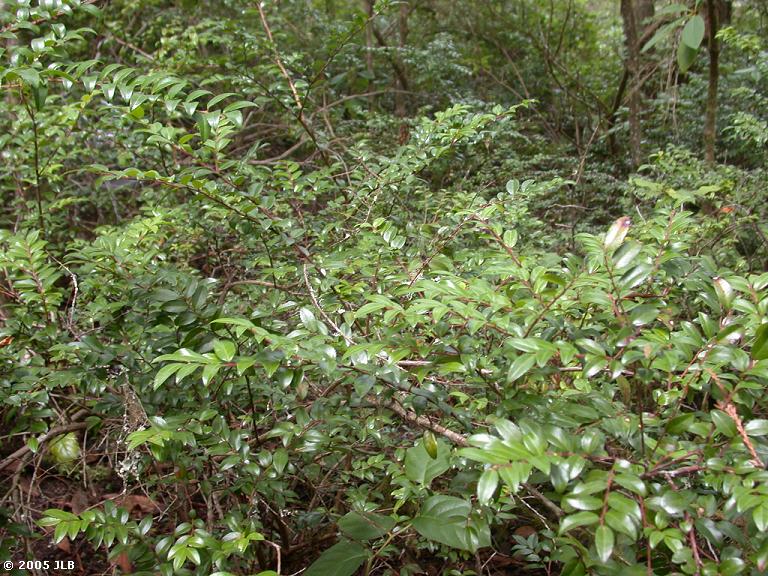
To conclude our investigation into the Pacific Rhododendron, I’d like to show you two of our subject rhododendron’s favorite neighbors, and dear friends of my own.

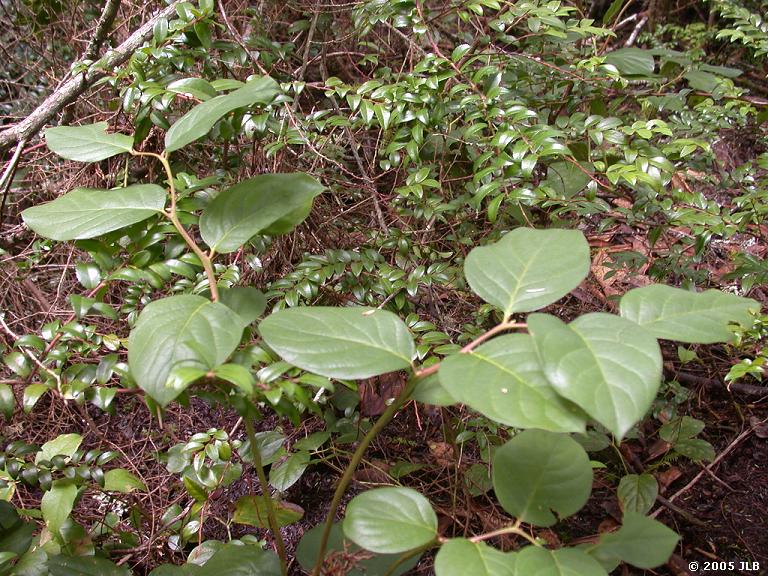
Meet Salal, and “Mystery-Bush” – two shrubby evergreens that grow happily along side the rhododendrons in my back yard in Seabeck. These two can be found in many other places around the Pacific Northwest.

The salal is the plant with the large round-ish leaves. Like the rhododendron, salal is a member of the family Ericaceae.

Unlike the parking-lot variety which are small and close to the ground, the salal growing in the forest interior have to reach high to stake their light claims, and most are over a meter tall. Others grow up to five meters high, often leaning on their neighbors for extra support.

As to “mystery-bush”… here is my quandary: I believe that it is a type of common huckleberry, also of the family Ericaceae, but I haven’t been able to confirm that. Another alternative would be that it is a shrub called boxwood (part of a different family, I believe). I am simply at a loss. Maybe they are one and the same, and it's merely a question of local word choice?

Whatever it is, this lovely plant produces swaths of tiny, pink fragrant blossoms which are followed by huge clumps of juicy, sweet, blue, violet, and black berries. Not only do the small birds and the bumble bees LOVE these plants, but apparently huskies do too!

Both of the husky dogs that have lived with me have enjoyed many an hour sitting beside these bushes, shucking the berries off like so much corn! Once they’ve finished with one bush, they move to the next one. The evidence of their efficient and voracious harvesting method is shown in the undigested leaves adorning each healthy poopy in the morning.

As a side note, we also have another huckleberry that grows around the forest which produces tiny, tart, red berries. As much as I might miss all my forest friends of Western Washington, I am so incredibly excited for my opportunity to meet all the plants of the East Coast!